I've just got the latest source book for the Iron Kingdoms RPG, and boy is it awesome.
This is only going to be a quick overview, as I haven't had enough time to read in depth, but a full review will appear in time.
The book is produced the same way as the core book, being a full colour hardback. While I haven't counted the pages yet, it has roughly the same page count as the core book, while containing much more fluff over rules!
The book is divided into 6 sections, covering the major kingdoms of Western Immorean. Not only does each section have a map and an outline of the kingdom's history, but it also includes geographic information, as well as the major mover's and shakers.
Each section also includes a players section which provides new careers, abilities, spells, gear and warjacks relevant to the nation. Anyone who wanted to play as one of the units from the wargame now has everything they need.
Overall this looks to be another excellent book. Only one gripe so far, and that their is a players section at the end of each nation, which while I understand works well layout wise, but is a pain for referencing. Especially as some of the abilities and spells are available to other careers.
However, I'm really looking forward to devouring the book, and will give a fuller review once I have.
Showing posts with label Review. Show all posts
Showing posts with label Review. Show all posts
Friday, 20 September 2013

Sunday, 5 May 2013
Iron Kingdoms GMs Kit - Review
I'm a bit behind with this review, but better late than never.
As is traditional in an RPG release schedule, one of the early releases is a GMs kit, containing a GMs screen and some additional content to entice us to hand over our money.
Not ones to break tradition, Privateer Press's second release in the Iron Kingdoms line is a Games Masters toolkit to aid all those hard working GMs in running their games.

The main component of the kit is the 4 pane games masters’ screen. With the panes orientated landscape, the screen is low enough that a GM can comfortably look over while sitting, but will hide notes and dice rolls from players. With a double sized centre panel, you have plenty of width to work with, and don't feel cramped with a pile of notes.
The screen is made from tough card, like the cover to the Iron Kingdoms core book. This means that it will easily stay standing on its own, and even absorb dice impacts without moving. This isn't a 1990's White Wolf screen here!
The outer screen graphics are up to the normal excellent standards of Privateer Press. The double sized pane gives a great opportunity for some metal mangling action, and it doesn't disappoint. You can’t get much more of a representative view of the Iron Kingdoms than a heavy warjack fighting a bionic pig man over a crashed steam engine.
On the inner screen is the real meat of the product, with useful tables and charts for reference in game. While I haven’t road tested the screen, it contains everything I would need to reference quickly during a game. It also includes page references for sections if you want to look at the full rules, which is really handy. The text is a reasonable size, and laid out well, making it easy to read. Use of bold text and inverted text colour for headings means that you can quickly find what you are looking for.
Onto the extras. These vary from company to company, some offering an adventure, others a small booklet of GM related material that didn't make the cut into the core book. In this case there are couple of gaming aids to help run your game.
To start us off, there is a pad of 25 full colour character sheets, like the ones found in the core book. Next, there is a pad of 25 full colour encounter sheets, again like the ones found in the core book. There are also 10 laminated Character health trackers and 10 laminated initiative trackers.
For me, while gorgeous quality, I'm unlikely to ever use the character or encounter sheets. Not that there is anything wrong with them, but I tend to find character sheets get used and abused in a way that doesn’t warrant using better than a black and white printout. Also, the paper is slightly gloss, and I'd imagine writing in pencil may be more difficult, leading to problems when changes needed to be made. It would also make the encounter sheets only usable once. That being said, there is nothing wrong with them, just a matter of personal preference.
The laminated health and initiative trackers though, I will be making use of. The health tracker gives the player an easy way to track life or damage (in the case of a warjack) and their current Feat Points, without having to keep rubbing out a section of the character sheet. The Initiative Tracker card, not only gives the GM a place to record individual initiative scores, but also a character's stats and current Armour and Defense, so they don't need to refer back to the player as often. While not vital to running a game, it certainly makes tracking things much easier.
Finally, perhaps the more difficult aspect is the product’s value for money. At $27.99 rrp, it is actually more expensive than Urban Adventures, and is likely to see less use. Looking at previous GMs screens I’ve bought, it is certainly much better than the screens I have for the FFG 40K RPGs, and just as good as my Eclipse Phase screen. For me, the additional items don’t quite have as much worth as the adventures/GMs books that the other screens provided, but I’m willing to let that go.
If you intend to run a game of Iron Kingdoms, you can’t go wrong by picking up the screen. The information it provides alone makes it a must have, saving time leafing through the rule book. Consider it an investment if nothing else.
As is traditional in an RPG release schedule, one of the early releases is a GMs kit, containing a GMs screen and some additional content to entice us to hand over our money.
Not ones to break tradition, Privateer Press's second release in the Iron Kingdoms line is a Games Masters toolkit to aid all those hard working GMs in running their games.
The main component of the kit is the 4 pane games masters’ screen. With the panes orientated landscape, the screen is low enough that a GM can comfortably look over while sitting, but will hide notes and dice rolls from players. With a double sized centre panel, you have plenty of width to work with, and don't feel cramped with a pile of notes.
The screen is made from tough card, like the cover to the Iron Kingdoms core book. This means that it will easily stay standing on its own, and even absorb dice impacts without moving. This isn't a 1990's White Wolf screen here!
The outer screen graphics are up to the normal excellent standards of Privateer Press. The double sized pane gives a great opportunity for some metal mangling action, and it doesn't disappoint. You can’t get much more of a representative view of the Iron Kingdoms than a heavy warjack fighting a bionic pig man over a crashed steam engine.
On the inner screen is the real meat of the product, with useful tables and charts for reference in game. While I haven’t road tested the screen, it contains everything I would need to reference quickly during a game. It also includes page references for sections if you want to look at the full rules, which is really handy. The text is a reasonable size, and laid out well, making it easy to read. Use of bold text and inverted text colour for headings means that you can quickly find what you are looking for.
Onto the extras. These vary from company to company, some offering an adventure, others a small booklet of GM related material that didn't make the cut into the core book. In this case there are couple of gaming aids to help run your game.
To start us off, there is a pad of 25 full colour character sheets, like the ones found in the core book. Next, there is a pad of 25 full colour encounter sheets, again like the ones found in the core book. There are also 10 laminated Character health trackers and 10 laminated initiative trackers.
For me, while gorgeous quality, I'm unlikely to ever use the character or encounter sheets. Not that there is anything wrong with them, but I tend to find character sheets get used and abused in a way that doesn’t warrant using better than a black and white printout. Also, the paper is slightly gloss, and I'd imagine writing in pencil may be more difficult, leading to problems when changes needed to be made. It would also make the encounter sheets only usable once. That being said, there is nothing wrong with them, just a matter of personal preference.
The laminated health and initiative trackers though, I will be making use of. The health tracker gives the player an easy way to track life or damage (in the case of a warjack) and their current Feat Points, without having to keep rubbing out a section of the character sheet. The Initiative Tracker card, not only gives the GM a place to record individual initiative scores, but also a character's stats and current Armour and Defense, so they don't need to refer back to the player as often. While not vital to running a game, it certainly makes tracking things much easier.
Finally, perhaps the more difficult aspect is the product’s value for money. At $27.99 rrp, it is actually more expensive than Urban Adventures, and is likely to see less use. Looking at previous GMs screens I’ve bought, it is certainly much better than the screens I have for the FFG 40K RPGs, and just as good as my Eclipse Phase screen. For me, the additional items don’t quite have as much worth as the adventures/GMs books that the other screens provided, but I’m willing to let that go.
If you intend to run a game of Iron Kingdoms, you can’t go wrong by picking up the screen. The information it provides alone makes it a must have, saving time leafing through the rule book. Consider it an investment if nothing else.
 |
| Iron Kingdoms Games Masters Tool Kit Contents |
Sunday, 28 April 2013
Godslayer Miniature Review
I ran across Godslayer by Megalith Games while they were running their Kickstarter recently. Unfortunately I wasn't able to seriously back them, but I was so taken with the miniatures I had to get a couple to paint.
Godslayer is a fantasy minatures skirmish game, that is set in their own world of Calydorn. To steal from their website:
So, I backed the Kickstarter enough to pick up the Halodyne Demarchon and Sanctum Priestess.
I'm pleased to say they arrived recently, and I thought I'd put together my thoughts on the models, in case anyone else was interested in buying some.
Both models came in ziplock bags, one with the model and parts, the other with the relevent game cards. While not as fancy as the clam shell blisters that most other companies use, I had no problem with the packaging, as lets be honest most of it goes in the bin. The models came well protected in a padded envelope so the lack of additional plastic blister wasn't necessary.

 On opening them up, what was promised in the online pictures became reality as the models were as beautifully sculpted as the pictures implied. The models were a bit smaller than I expected, they are advertised as true 32mm scale, but I think I'm so used to painting "heroic" scale 28mm models that I lose touch with realistic sizes. Don't let this detract you from the models though, as they are wonderfully dynamic in their sculpts.


The models are in metal, something that is becoming a bit of a rarity these days. Personally I don't have a preference between plastic, resin or metal, but I realise that some people do.
Both models came in a number of pieces, and they went together well, with no more preparation work than you would expect from any other company. Mould lines were obvious, and for the most part in areas making cleaning easy. A couple though were in areas of small detail, which was unfortunate, but just took a bit more concentration.
Because it seems I am slower at writing blog posts than I am at painting, I've managed to finish the Demarchon in time to show you a finished model!


I certainly intend to take a look at the Godslayer Quickstart rules when I get a chance. I'd like to pick up a few of the other models in the range as well, but my painting pile is big enough right now, it might have to wait.
Anyone looking to buy into Godslayer, from the quality of the models you would be daft not to. Not that I do ratings on my reviews, but if I did they'd be up there with the best.
Godslayer is a fantasy minatures skirmish game, that is set in their own world of Calydorn. To steal from their website:
"The world of Calydorn is the stage upon which plays the epic drama of GODSLAYER; a bronze-age world of sword and sorcery; steeped in the ruins of ancient civilizations, where the borders of myth and reality blur. Classical empires clash, spear and shield, in contest for cultural dominance; brutal barbarians command the skies astride the backs of giant avians while slave-caravans wend their way across endless deserts with their cargos of the conquered."What particularly interested me were the Halodyne faction, a basic port of Ancient Greek warriors into their world. I've always liked the look of the classical Hoplite infantry, and I like to branch out now and again to keep my painting varied.
So, I backed the Kickstarter enough to pick up the Halodyne Demarchon and Sanctum Priestess.
I'm pleased to say they arrived recently, and I thought I'd put together my thoughts on the models, in case anyone else was interested in buying some.
Both models came in ziplock bags, one with the model and parts, the other with the relevent game cards. While not as fancy as the clam shell blisters that most other companies use, I had no problem with the packaging, as lets be honest most of it goes in the bin. The models came well protected in a padded envelope so the lack of additional plastic blister wasn't necessary.


The models are in metal, something that is becoming a bit of a rarity these days. Personally I don't have a preference between plastic, resin or metal, but I realise that some people do.
Both models came in a number of pieces, and they went together well, with no more preparation work than you would expect from any other company. Mould lines were obvious, and for the most part in areas making cleaning easy. A couple though were in areas of small detail, which was unfortunate, but just took a bit more concentration.
Because it seems I am slower at writing blog posts than I am at painting, I've managed to finish the Demarchon in time to show you a finished model!


I am really pleased with the final result. I had intended to try non-metallic bronze, however I didn't feel confident enough so instead used a combination of traditional metallic paint and NM shading. The skin toning isn't quite as smooth as I'd like, but it is better than some of my previous attempts. I also want to put a few more touches to the base, but I'm not sure what yet!
Anyone looking to buy into Godslayer, from the quality of the models you would be daft not to. Not that I do ratings on my reviews, but if I did they'd be up there with the best.
Sunday, 24 March 2013
Hordes: Gargantuans - Review
I was a little delayed in getting my copy of Gargantuans due to my LGS’ supplier having an issue with “flammable pallets”. I feel this is an excuse along the lines of “the dog ate my homework”, but as I wasn’t going to buy it anywhere else, I had to wait.

However, patience is a virtue, and I even successfully managed to avoid all the online spoilers!
And I’m glad that I did, as once again Privateer Press has produced and excellent product that I would have been disappointed had I spoiled myself before having my own copy.
Gargantuan’s is a 160 page, full colour book available in both softback and hardback for those collectors out there. As with all the previous anthology books, it contains sections on painting, new rules, new model write ups and fiction highlighting the new models as well as advancing the world metaplot.
Just like the Warmachine equivalent Colossals, Gargantuans contains the relevant new rules that covers the new unit type, as well as publishing the Unbound rules again. While Unbound is an interesting change to the game (for those out there with 200pts+ of models), if you have either Colossals, or the original No Quarter issue, these rules are duplication. The only new part is the new formations, and changes to existing models if you want to play Unbound. While I’m disappointed that Unbound has been included again, I’m not sure of any better way of publishing it. I can’t see an Unbound rulebook on its own selling well.
The painting section, once again highlights some of the techniques used to paint the display models. Not everyone is going to want to replicate the paint schemes, but they do make interesting reading for picking up techniques. Along with the painting sections from the faction books, and available in No Quarter, there is a wealth of well written pieces for anyone looking to improve or expand their painting techniques.
For me, as much as I’m looking forward to the new models, I’m also looking forward to the fiction in the books. Privateer Press has built up a great setting and metaplot, and anything to build in that is welcome in my opinion. Once again, we are treated to some excellent stories that not only see the new models do awesome stuff, but the overall plot move forward. As we go on, the Warmachine and Hordes metaplots are becoming more intertwined, and we see the effects of battles in Colossals being played out here. I’m really interested in the Cryx/Legion story as well as the Skorne/Ios plot lines. All in all, excellent writing as usual, if anything it serves to make mediocre models seem much more impressive than they are on the table. Not a bad thing in my opinion!
Anyway, onwards to what everyone really cares about, the new model releases.
I’ll be honest, its tough for me to give much of an overview of the factions other than Legion and Skorne, so take any commentary on the other faction releases with a pinch of salt!
Overall, this has more releases than Colossals, with at least another beast and 2 solos/units per faction above the Warlock & Gargantuan we expected.
Trollbloods
Trolls gets themselves a Warlock unit in the shape of Grimm2, a light troll with Stealth and Eyeless sight, a heavy champions unit and 2 solos (one Sorcerer that attaches to a unit, and a Fennblade commander). While considered the weakest of the Gargantuans, you can’t dispute the Mountain King model is amazing. I wouldn’t say anything here is out of the park outstanding, but a solid set of releases that I would expect to see play.
Circle
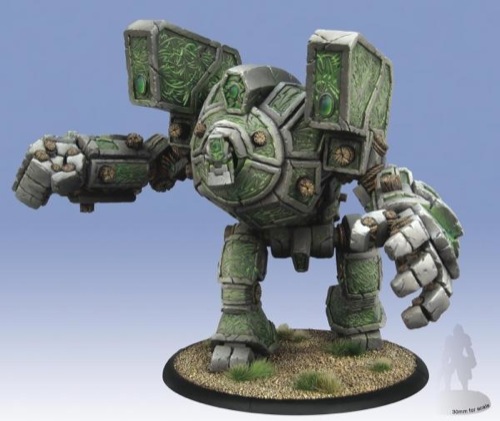 I really don’t like the look of Morvahna2, Circles new mounted warlock. With a strong feat and set of spells and abilities, I can easily see her causing trouble in play. Another strong release is the Warpborn Alpha UA for the Skinwalkers unit. For 3 points you get a whole raft of abilities to make your medium based infantry even better. Their unit release, the Tharn Blood Pack also look mighty strong, and the Rip Horn Satyr promises to find its way into many lists. Compared to these releases, the Razorwing Griffon and Woldwrath Gargantuan do feel a little lacklustre, but I don’t doubt someone will make them work.
Skorne
For me, Skorne get some of the most interesting and powerful new models. Makeda3 is our Warlock Unit, and if you want to play a Warlock that gets into the middle of the action, then she is for you. She has the ability to dish it out, and to keep herself reasonably protected from retaliation. I think she’s definitely on the to-buy list.
Our weakest release is the Reptile Hound, a Lesser Warbeast with a situational animus, and Flank with Reptile Hounds, meaning you have to take at least 2 to make them worthwhile. We do, however, get the only Character Warbeast in the book, in the shape of the Despoiler. With an Affinity for Mordikaar, you wouldn’t be surprised to know he works at producing Void Spirits and supports spell casting. His animus doubles enemy fury and focus costs to cast spells, and he’s not a slouch in combat for a heavy beast.
Our unit is a ranged Cataphract unit, that have Continuous Fire and an AoE! These fill a much needed gap in our roster, and I can see in more than just Xerxis lists. Our Solo, the Mortitheurge Willbreaker, will, however, be found in even more lists. For 2 points you get Beast Master, Ancillary Attack and Puppet Master! Best Release of the Book.
If that wasn’t enough, our Gargantuan, the Mammoth, is easily the best of the large based models. A giant 4 armed monster with a 4 barrelled cannon on its back, yes please! Add in the ability to total anything in melee, and the most armour of them all, I can’t wait to drop this guy onto the table.
Legion of Everblight

Legion gets some interesting releases, but really only one has made it onto my to-buy list.
They do have the privilege of the first Huge based Warcaster in the shape of Lylyth3. Counting as a Battle Engine, and mounted on a sledge pulled by 2 Ulks, this should be an amazing model, but how it performs in game is yet to be seen. I’m concerned that a huge base makes her much too difficult to hide from opposing assassination attempts.
Legion gets 2 light warbeast, the Afflictor and Nephilim Bloodseer. Both are interested with both having Flight, the Afflictor creating new Incubi and the Bloodseer improving spell casting units. Solid releases that will see play in certain lists.
No unit for Legion this time, but 2 interesting solos. The Beast Mistress is a spell casting equivalent to a Jack Marshall. Only able to take Lesser Warbeasts, but packing a couple of spells herself, I can imagine she’ll end up as a Legion Buff bot for those useful Lesser animi. The second solo is the Warspear Chieftain, a UA for the Warspear unit. Much like the Warpborn Alpha, he brings the Warspears much needed abilities such as Huntsman and Relentless Charge, for the bargain price of 2 points.
Legion do win the prize for the most amazing looking Gargantuan. Unfortunately, its rules don’t quite match, but I can still see if getting some table time.
Minions
Minions get 2 warlocks, one Farrow and one Gatorman. Of the two, I like the look of Rask (Gatorman) better, but I am a sucker for the Gatorman faction. The Farrow get a Lesser Warbeast and Blindwater get an Undead Bog Trog unit. There is also a new Gobber Tinker solo that can repair Warjacks and Battle Engines. However, as he only works for 2 of the Warmachine factions compared to all 4 Hordes ones, I can see him repairing more Battle Engines than anything else.
Overall, another excellent release from Privateer Press. Every faction gets something useful, and while debate will reign over which faction “won” the book, I think no one goes away unhappy.
I already have a couple of the early releases, which I'll review in a week, once I've got them put together.
However, patience is a virtue, and I even successfully managed to avoid all the online spoilers!
And I’m glad that I did, as once again Privateer Press has produced and excellent product that I would have been disappointed had I spoiled myself before having my own copy.
Gargantuan’s is a 160 page, full colour book available in both softback and hardback for those collectors out there. As with all the previous anthology books, it contains sections on painting, new rules, new model write ups and fiction highlighting the new models as well as advancing the world metaplot.
Just like the Warmachine equivalent Colossals, Gargantuans contains the relevant new rules that covers the new unit type, as well as publishing the Unbound rules again. While Unbound is an interesting change to the game (for those out there with 200pts+ of models), if you have either Colossals, or the original No Quarter issue, these rules are duplication. The only new part is the new formations, and changes to existing models if you want to play Unbound. While I’m disappointed that Unbound has been included again, I’m not sure of any better way of publishing it. I can’t see an Unbound rulebook on its own selling well.
The painting section, once again highlights some of the techniques used to paint the display models. Not everyone is going to want to replicate the paint schemes, but they do make interesting reading for picking up techniques. Along with the painting sections from the faction books, and available in No Quarter, there is a wealth of well written pieces for anyone looking to improve or expand their painting techniques.
For me, as much as I’m looking forward to the new models, I’m also looking forward to the fiction in the books. Privateer Press has built up a great setting and metaplot, and anything to build in that is welcome in my opinion. Once again, we are treated to some excellent stories that not only see the new models do awesome stuff, but the overall plot move forward. As we go on, the Warmachine and Hordes metaplots are becoming more intertwined, and we see the effects of battles in Colossals being played out here. I’m really interested in the Cryx/Legion story as well as the Skorne/Ios plot lines. All in all, excellent writing as usual, if anything it serves to make mediocre models seem much more impressive than they are on the table. Not a bad thing in my opinion!
Anyway, onwards to what everyone really cares about, the new model releases.
I’ll be honest, its tough for me to give much of an overview of the factions other than Legion and Skorne, so take any commentary on the other faction releases with a pinch of salt!
Overall, this has more releases than Colossals, with at least another beast and 2 solos/units per faction above the Warlock & Gargantuan we expected.
Trollbloods
Trolls gets themselves a Warlock unit in the shape of Grimm2, a light troll with Stealth and Eyeless sight, a heavy champions unit and 2 solos (one Sorcerer that attaches to a unit, and a Fennblade commander). While considered the weakest of the Gargantuans, you can’t dispute the Mountain King model is amazing. I wouldn’t say anything here is out of the park outstanding, but a solid set of releases that I would expect to see play.
Circle
I really don’t like the look of Morvahna2, Circles new mounted warlock. With a strong feat and set of spells and abilities, I can easily see her causing trouble in play. Another strong release is the Warpborn Alpha UA for the Skinwalkers unit. For 3 points you get a whole raft of abilities to make your medium based infantry even better. Their unit release, the Tharn Blood Pack also look mighty strong, and the Rip Horn Satyr promises to find its way into many lists. Compared to these releases, the Razorwing Griffon and Woldwrath Gargantuan do feel a little lacklustre, but I don’t doubt someone will make them work.Skorne
For me, Skorne get some of the most interesting and powerful new models. Makeda3 is our Warlock Unit, and if you want to play a Warlock that gets into the middle of the action, then she is for you. She has the ability to dish it out, and to keep herself reasonably protected from retaliation. I think she’s definitely on the to-buy list.
Our weakest release is the Reptile Hound, a Lesser Warbeast with a situational animus, and Flank with Reptile Hounds, meaning you have to take at least 2 to make them worthwhile. We do, however, get the only Character Warbeast in the book, in the shape of the Despoiler. With an Affinity for Mordikaar, you wouldn’t be surprised to know he works at producing Void Spirits and supports spell casting. His animus doubles enemy fury and focus costs to cast spells, and he’s not a slouch in combat for a heavy beast.
Our unit is a ranged Cataphract unit, that have Continuous Fire and an AoE! These fill a much needed gap in our roster, and I can see in more than just Xerxis lists. Our Solo, the Mortitheurge Willbreaker, will, however, be found in even more lists. For 2 points you get Beast Master, Ancillary Attack and Puppet Master! Best Release of the Book.
If that wasn’t enough, our Gargantuan, the Mammoth, is easily the best of the large based models. A giant 4 armed monster with a 4 barrelled cannon on its back, yes please! Add in the ability to total anything in melee, and the most armour of them all, I can’t wait to drop this guy onto the table.
Legion of Everblight
Legion gets some interesting releases, but really only one has made it onto my to-buy list.
They do have the privilege of the first Huge based Warcaster in the shape of Lylyth3. Counting as a Battle Engine, and mounted on a sledge pulled by 2 Ulks, this should be an amazing model, but how it performs in game is yet to be seen. I’m concerned that a huge base makes her much too difficult to hide from opposing assassination attempts.
Legion gets 2 light warbeast, the Afflictor and Nephilim Bloodseer. Both are interested with both having Flight, the Afflictor creating new Incubi and the Bloodseer improving spell casting units. Solid releases that will see play in certain lists.
No unit for Legion this time, but 2 interesting solos. The Beast Mistress is a spell casting equivalent to a Jack Marshall. Only able to take Lesser Warbeasts, but packing a couple of spells herself, I can imagine she’ll end up as a Legion Buff bot for those useful Lesser animi. The second solo is the Warspear Chieftain, a UA for the Warspear unit. Much like the Warpborn Alpha, he brings the Warspears much needed abilities such as Huntsman and Relentless Charge, for the bargain price of 2 points.
Legion do win the prize for the most amazing looking Gargantuan. Unfortunately, its rules don’t quite match, but I can still see if getting some table time.
Minions
Minions get 2 warlocks, one Farrow and one Gatorman. Of the two, I like the look of Rask (Gatorman) better, but I am a sucker for the Gatorman faction. The Farrow get a Lesser Warbeast and Blindwater get an Undead Bog Trog unit. There is also a new Gobber Tinker solo that can repair Warjacks and Battle Engines. However, as he only works for 2 of the Warmachine factions compared to all 4 Hordes ones, I can see him repairing more Battle Engines than anything else.
Overall, another excellent release from Privateer Press. Every faction gets something useful, and while debate will reign over which faction “won” the book, I think no one goes away unhappy.
I already have a couple of the early releases, which I'll review in a week, once I've got them put together.
Sunday, 10 February 2013
Iron Kingdoms: Urban Adventure Review

I'm a bit slow on this one, as the book was released just before Christmas, however the for-mentioned holiday delayed me giving the book a good read. That has now been rectified, so on with the review.
No Quarter Presents: Iron Kingdoms Urban Adventure is the first source book in the Iron Kingdoms Full Metal Fantasy Roleplaying Game and aims to claim the title of the longest source book title ever released. Weighing in at 94 pages, it won't win any prizes for the largest book in the world, but in full colour it certainly wins on quality.
Urban Adventure is providing rules and information for both GMs and players who want more information on adventuring in an urban environment.
First up are 6 new careers, one for each of the non human races that serve to help bolster there character options. Some, like the Seeker and Labour Korune are very much linked to their racial fluff but I'm sure Pugilist could be adapted for a human. They look good, and combined with the existing careers will lead to some interesting characters. Certainly it will help mesh some of the races into an Urban Campaign
8 pages of new equipment follow, from weaponry to new alchemical potions. Nothing outstanding, but some useful additions.
Perhaps one of the more interesting sections, is a section on Urban Combat. This section introduces some new combat techniques that any character can use to make combat encounters more interesting and varied. They all need a reasonable skill prerequisite (usually 2 in the relevant skill) and the expenditure of a feat point to attempt. For those that are familiar with the wargame, think power attacks! I look forward to seeing more options in future source books.
Next we get 6 pages devoted to labour jacks, including new chassis and upgrades to existing ones. Describing the types of jacks you would see working in an urban environment, they are also solid starts for adventuring companies to adapt into combat jacks.
The largest section of the book, clocking it at 20 pages, is an concise outline of the city of Five Fingers. As stated in the contents, this material is not new but instead has been taking from a previous Iron Kingdoms product. Even owning the original book, I don't feel cheated as the concise guide is well done and gives a nice outline and chance at game ideas without the need to wade through an entire book. For those that want to run a game set in Five Fingers, I would strongly advise picking up Five Fingers: Port of Deceit if you can. If you don't, then the section is full of flavour, and I'm sure you'll find something to inspire you.
The Urban Encounters section provides 4 encounters that can easily be adapted and fitted into an existing campaign. These can serve as jumping in points, or simply a break from your over arcing plot. I'm certainly looking at using a couple for my next game.
For those attracted by the dark side, the Sevants of Thamar section gives you a wealth of information for both playing, and running characters who worship Thamar. Included is a new career (Thamar Advocate), as well as specific abilites and spells to the career. As well as more about being a Thamar worshipper, we get information on Necromancy, and new rules on creating your own Thralls. This section is excellent for GMs wishing to either strongly feature Thamar worshippers, or Undead. The career is usable as a PC career, but it may be difficult to make best use of all there abilities in an average adventuring party. Still, always fun for someone.
In an interesting combination of fluff and crunch, there are 2 pages on criminal adventuring companies PCs can be part of. As well as providing bonuses for characters who meet their pre-requisites, these make interesting foils for more law-abiding adventuring groups. Usefully, there is also a table giving you an idea of the severity of crimes in each country. Not surprisingly, wracking features strongly in the Menoth list of punishments.
Finally is a detailed adventure for characters with 10 - 15xp. This is a 3 act adventure, and would do well as a one-shot, or working into a longer running campaign. While it would be difficult to move out of the Five Fingers setting, there are suggestions of how to get groups involved. As well as NPC stats, there are decent maps and combat tactics. The maps are also available online as a high quality PDF that can be printed out and put together to provide the full size map for each encounter. The adventure itself looks solid, with a nice mixture of combat and investigation.
Overall, I'm very pleased with this product. While not as in-depth as some source books, it certainly wins on quality over quantity. While GMs will obviously get the most out of this book, players in a campaign set in Five Fingers will find this invaluable as a source of setting information.
I look forward to more Iron Kingdoms books, as well as the Games Masters Toolkit.
Monday, 22 October 2012
Iron Kingdoms RPG Review
It's been a while since I've had a new RPG to review since I've started becoming a lot more selective with my gaming purchases. That, and many of the lines I was buying have slowed down considerably! However, this one is well worth singing its praises.
I don't think it would shock anyone to say I'm a huge Iron Kingdoms fan. I bought the 2 of the original Warmachine battle boxes, despite not having anyone to play against at the time. With the exception of the Force Books for armies I don't play, I have all the rule books from Mk1 Prime. I even bought 2 of the original Hordes Battle Boxes when I still didn't have anyone to play against. (forever the optimist!)
The Iron Kingdoms though, didn't start off in the miniatures game. It originally existed as part of a adventure trilogy for 3rd Edition D&D published under the OGL. The Witchfire Trilogy was so popular that eventually a small RPG line was published alongside the emerging miniatures game. WHile the setting was good, unfortunatley the use of OGL D20 caused some issues meshing gameplay to player's expectations, especially once they saw what the equivilent unit in the miniatures game could do. While I did run the Witchfire Trilogy (its an awesome campaign BTW. Key moment in Iron Kingdoms history, great set peices and classic NPCs) the D20 rules held us back, and Gun Mages and anyone wanting to craft stuff was seriously disadvantaged.
When Privateer Press started work on Mark 2 Warmachine, they put a hold on the entire RPG line, promising to re-visit it with a new system once Mark 2 was up and running.
Roll on a couple of years, and we now have one of the best looking RPG books around.
 With production values on par with the Warmachine/Hordes rule books (and light years beyond the original Iron Kingdoms Character Guide), the new Iron Kingdoms RPG is a full colour hardback book, weighing in at 340 pages.
Kicking off the book is an excellent section on the history of Western Immoren. Covering prehistory, all the way up to the "modern" day, this is a great introduction to the world. Much of this history has been covered in various of the miniature books, but it is well written and worth having in one place. Following swiftly afterwards is a section looking at aspects of Western Immoren as it stands, including magic, religion and Mechanika. These two sections total over 100 pages and gives even those completely new to the setting everything they need to know.
Character creation gives you the chance to get into the crunchy parts of the book. Building from a stat line that will look familiar to anyone who's played the miniature game, each character gets to pick a race, archetype and 2 careers to form the backbone of the character. The races feature all the options available in the original RPG, and cover just those living in Western Immoren, later books will open up options to play Skorne and some of the more exotic races. The careers are much like you would expect with classes key to the setting such as the Alchemist, Gunmage and Warcaster represented along with more generic, but equally important careers such as soldier and spy. With each character picking 2, it leads to much more variation and gives much more opportunities for creating interesting characters.
Each career seems balanced, with even the lowly Spy being able to bring something to the table when up against Warcasters and Gunmages.
The conflict resolution system is very similar to the miniatures game, with the combat and magic systems being a pretty straightforward port. While I don't find that a problem, some people may find the overly tactical combat system, which works better with miniatures, to be a problem. Certainly it would not take much to shift to a miniature-less combat, and there is a section in the back that covers this, but otherwise they expect models on the table.
One of the biggest flaws in the D20 version was always the crafting. In the setting, magical items are rare, with most "magical" items actually being Mechanika, a blend or magic and technology. However D20 could never handle this, and so you ended up with much of the fun classes (Alchemist and Arcane Mechanic) being hobbled and unable to be truly awesome. Thankfully the new book presents crafting in a manner that really fits with the setting, and allows crafting classes to be really useful.
My only real gripe is there is not enough in the book. Its a poor gripe, but a valid one, as there is so much crammed in, that some sections are much shorter than I'd have liked. The antagonists section feels especially small, but this is being supported via the No Quarter magazine (and excellent publication for Iron Kingdoms fans) and online. Given the scope of the setting, there is plenty of material and I look forward to an updated Monsternomicon.
Overall, the Iron Kingdoms RPG is an excellent successor to the D20 variant, and continues the tradition of excellent products that started all those years ago with the Witchfire Trilogy.
I don't think it would shock anyone to say I'm a huge Iron Kingdoms fan. I bought the 2 of the original Warmachine battle boxes, despite not having anyone to play against at the time. With the exception of the Force Books for armies I don't play, I have all the rule books from Mk1 Prime. I even bought 2 of the original Hordes Battle Boxes when I still didn't have anyone to play against. (forever the optimist!)
The Iron Kingdoms though, didn't start off in the miniatures game. It originally existed as part of a adventure trilogy for 3rd Edition D&D published under the OGL. The Witchfire Trilogy was so popular that eventually a small RPG line was published alongside the emerging miniatures game. WHile the setting was good, unfortunatley the use of OGL D20 caused some issues meshing gameplay to player's expectations, especially once they saw what the equivilent unit in the miniatures game could do. While I did run the Witchfire Trilogy (its an awesome campaign BTW. Key moment in Iron Kingdoms history, great set peices and classic NPCs) the D20 rules held us back, and Gun Mages and anyone wanting to craft stuff was seriously disadvantaged.
When Privateer Press started work on Mark 2 Warmachine, they put a hold on the entire RPG line, promising to re-visit it with a new system once Mark 2 was up and running.
Roll on a couple of years, and we now have one of the best looking RPG books around.
With production values on par with the Warmachine/Hordes rule books (and light years beyond the original Iron Kingdoms Character Guide), the new Iron Kingdoms RPG is a full colour hardback book, weighing in at 340 pages. Kicking off the book is an excellent section on the history of Western Immoren. Covering prehistory, all the way up to the "modern" day, this is a great introduction to the world. Much of this history has been covered in various of the miniature books, but it is well written and worth having in one place. Following swiftly afterwards is a section looking at aspects of Western Immoren as it stands, including magic, religion and Mechanika. These two sections total over 100 pages and gives even those completely new to the setting everything they need to know.
Character creation gives you the chance to get into the crunchy parts of the book. Building from a stat line that will look familiar to anyone who's played the miniature game, each character gets to pick a race, archetype and 2 careers to form the backbone of the character. The races feature all the options available in the original RPG, and cover just those living in Western Immoren, later books will open up options to play Skorne and some of the more exotic races. The careers are much like you would expect with classes key to the setting such as the Alchemist, Gunmage and Warcaster represented along with more generic, but equally important careers such as soldier and spy. With each character picking 2, it leads to much more variation and gives much more opportunities for creating interesting characters.
Each career seems balanced, with even the lowly Spy being able to bring something to the table when up against Warcasters and Gunmages.
The conflict resolution system is very similar to the miniatures game, with the combat and magic systems being a pretty straightforward port. While I don't find that a problem, some people may find the overly tactical combat system, which works better with miniatures, to be a problem. Certainly it would not take much to shift to a miniature-less combat, and there is a section in the back that covers this, but otherwise they expect models on the table.
One of the biggest flaws in the D20 version was always the crafting. In the setting, magical items are rare, with most "magical" items actually being Mechanika, a blend or magic and technology. However D20 could never handle this, and so you ended up with much of the fun classes (Alchemist and Arcane Mechanic) being hobbled and unable to be truly awesome. Thankfully the new book presents crafting in a manner that really fits with the setting, and allows crafting classes to be really useful.
My only real gripe is there is not enough in the book. Its a poor gripe, but a valid one, as there is so much crammed in, that some sections are much shorter than I'd have liked. The antagonists section feels especially small, but this is being supported via the No Quarter magazine (and excellent publication for Iron Kingdoms fans) and online. Given the scope of the setting, there is plenty of material and I look forward to an updated Monsternomicon.
Overall, the Iron Kingdoms RPG is an excellent successor to the D20 variant, and continues the tradition of excellent products that started all those years ago with the Witchfire Trilogy.
Sunday, 12 August 2012
Dropzone Commander Rules Review
My Dropzone Commander rules arrived a couple of weeks ago, and after reading the book through I'm ready to write up my thoughts.
Presentation

There is a nice write up of the background to the setting at the start, giving the rules a grounding in the background. Nothing ground breaking in the background, but it is solid and well thought out. Each faction gets a couple of pages of background before a complete list of the units in the initial release wave. As a bonus you also get some alternate schemes painted up for those that aren’t taken with the studio schemes.
Rules
This is my opinion based on a read through of the rules. Obviously to get a full understanding of them, there is not substitute to playing, but I'm still putting together my starter armies.
The first thing that struck me as I read the rules was how simple it is, while still maintaining depth. It’s great to see a sci-fi game where the focus can be on shooting, with infantry combat being only a minor aspect. In fact infantry combat seems to be one of the more complicated areas of the game. I need to read that section again to get a decent grasp on what’s going on. G
I think the game meshes ground based and aerial combat well, with fighters mainly being called in for strafing runs and not having to hang around on board being shot at. Given the scale, battlefield manoeuvrability comes from the dropships which will make battles much more fluid. Having your units move around under their own power actually can result in very little movement depending on the unit.
Another excellent feature is the turn sequence, which sees each player activating small portions of their forces at a time, allowing for strategic reactions to your opponents actions. No longer will you find you forces annihilated in a single turn and being unable to react. Instead you have a chance to try and repair poor tactical decisions, or at least run away from what’s killing you.
Terrain plays a major role in the game, as does playing scenarios rather than straight up annihilate the enemy battles. The book comes with a selection of scenarios with options to improve them based on the points size of the battle you are playing. In the scenarios objectives are located within buildings meaning your infantry has to go in and get them. Without terrain, the game would very quickly go to the force with the longest range, which isn’t all that fun.

Perhaps the area with the most complexity is the army construction rules, although this does seem to be partly due to future proofing than anything else. Also, with so few army options at the moment, you might find yourself falling quite short of the points limits.
Conclusion
Overall, I'm extremely happy with the Dropzone Commander rules. They have lived up to the promise of the miniatures and I eagerly await a chance to give these rules a try. The book is a bargain at £15 with a decent amount of fluff mixed in with the rules.
With luck I’ll be getting a game in at the end of the month, and I’ll write up thoughts on how the game plays then.
Wednesday, 25 July 2012
DropZone Commander Miniature Review
Since being premièred at Salute 2012, Hawk Wargames DropZone
Commander has been an eagerly awaited release. We have been teased with gorgeous images of the units but now we have them in our hands!!
The pre-orders for DzC came during a self imposed spending
freeze on gaming, however I justified a small purchase of some mini’s for “review
purposes”. So, I suppose I’d better do a review.
I purchased 3 models, a Jaguar Warstrider from the Shaltari faction, and a pair of Hyperion Heavy Walkers and a Neptune Medium Dropship from the PHR. Given I'm likely to go either with Shaltari or PHR when I invest in an army, I picked things that the starter sets didn't include, but seemed useful in the long run. Without a look at the army building rules, I was shooting in the dark, but I think I've succeded.

Here they are in their blister packs. Packaging is decent, with enough foam packaging to avoid the parts rattling around too much, while the blister pack itself is a pretty standard clamshell design. Down side of these packs were the lack of identifying markings on the outside of the pack. I would expect that retail packages will come with a sticker somewhere on the outside to inform the customer what they are picking up, otherwise I can see new players picking up the wrong blisters.
Lets take a look at what you get in each blister.
 |
| Jaguar Warstrider |
 |
| Hyperion Heavy Walkers |
 |
| Neptune Dropship |
The first thing you notice when you've got the parts in hand is the detail. It is amazingly detailed, exactly as the preview pictures on the website show. Companies sell us on resin minatures because of the detail it offers, but they rarely produce models that take advantage of it. Hawk Wargames, however, have show what can be achieved with resin minatures! They are so detailed I'm almost scared to undercoat them in case I loose some of it.
The new widget that comes with the Neptune Dropship is a great idea, making transport of the air models so much easier.
Taking a closer look, there are some obvious flashing that needed to be removed, but very few mould lines. Having worked with other companies resin/plastic resin models, I'm very impressed with how this formula handles. The flashing was easily removed with either a side cutter or knife, with no cracking, and it was all located in flat areas so no detail was lost. Mould lines were easily filed away, as were the odd blemish. The underside of the Jaguar's "head" hadn't quite come out as crisp as the rest of it, but nothing a small drill didn't rectify. Across the 3 models I found only 3 air bubbles, that will easily be cleaned up with some liquid green stuff.
Games Workshop take note, this is how you ship resin models. Perhaps you should ask Hawk Wargames for some tips?
The miniatures went together beautifully, with only super glue needed to bond the pieces together securely. If anything, it was a little too quick to bond as you get next to no time to tweak the positioning of legs. However, we shouldn't complain, then these models shouldn't need any pinning at all.
I've been waiting eagerly for these miniatures, and I have not been disappointed. If the rest of the range is this good, then we are in for a real treat. I cannot wait to get painting these, although first I need to decide on a paint scheme.
My only regret, I didn't pre-order the rule book at the same time. However, I know a few people with one, so I'm hoping to nab a look at one in the near future. When I have, expect a review of the rules.
 |
| Jaguar Warstrider |
 |
| Neptune Medium Dropship |
 |
| Hyperion Heavy Walkers |
My only regret, I didn't pre-order the rule book at the same time. However, I know a few people with one, so I'm hoping to nab a look at one in the near future. When I have, expect a review of the rules.
Monday, 7 November 2011
Hugo Awards - Revisited
A while back I said I'd read and review the 5 books on the Hugo Awards list for this year.
I did well on this, read 3 out of the 5 books before the awards and managed to review 2 of them. Problem was, I was let down by the library copy of One Hundred Thousand Kingdoms going walkies for a couple of months. Poor excuse I know, but it’s the only one I’ve got.
This year’s winner was
Blackout/All Clear by Connie Willis, a duology that masquerades itself as a
single novel. I managed to read Blackout before it won, but All Clear was only
published in the UK
after the Hugo was awarded.
Wednesday, 17 August 2011
Review: Warmachine Wrath
Wrath is the first expansion book for Mark II Warmachine. Following the same format as previous expansion books (Escalation, Apotheosis, Superiority & Legends) Wrath contains new units for all of the factions, as well as fiction that moves the setting forward.
Introduced in Wrath is a new unit type, the Battle Engine! Large based models, that come with powerful abilities, these units should change the way you play your force.
Introduced in Wrath is a new unit type, the Battle Engine! Large based models, that come with powerful abilities, these units should change the way you play your force.
Tuesday, 12 July 2011
RPG Review: Pathfinder: Ultimate Magic
Time to get back into the swing of writing reviews for the RPG books I buy!
Review: Pathfinder Ultimate Magic
I've been a big fan of what Paizo have been doing with Pathfinder. While I don't buy the setting specific books, the basic core rules have all been excellent books, high quality and avoiding the rules bloat that afflicted 3.5 and seems to be continuing in 4th Edition.
Sunday, 5 June 2011
Book Review: The Girl with the Dragon Tattoo by Stieg Larsson
I read this a while ago, and have been meaning to get a review up of it. Something well outside my normal reading zone, but I kept getting people at work saying I must read it, and for the sake of my job I have done!
Book: The Girl with the Dragon Tattoo
Author: Stieg Larsson
Mikael Blomqvist, a journalist for the Millennium magazine in Stockholm and facing a three month jail sentence for libel, is hired by industrialist Henrik Vagner to solve the forty year old mystery of the disappearance of Vagner's niece Harriot. In doing so, Blomqvist will find that some families have dark secrets that don't want to see the light, and that allies can come from the unlikeliest of places.
Wednesday, 1 June 2011
Book Review: Dervish House by Ian McDonald
Dervish House was the first of the Hugo books I read, but its taken me a bit to compose my thoughts about it. If that's a good thing or not, you'll just have to read the full review to find out!
Novel: Dervish House
Author: Ian McDonald
Set in the background of Istanbul in 2027, Dervish House is a novel that is steeped in both mysticism and nanotechnology. Following the fortunes of six characters across 7 days, the book weaves together the threads of the story to create a riveting story full of drama, conflict and intrigue.
Tuesday, 24 May 2011
Book Review: Feed by Mira Grant
I've actually read 2 of the Hugo nominees so far, I'm just behind on my reviews. This was the last one I read, I'm going to have to think a bit further on Dervish House before I put up a review.
Novel: Feed
Author: Mira Grant
In 2014, an act of eco-terrorism releases an untested cure for the common cold into the atmosphere. Days later, upon coming into contact with an experimental cancer cure it mutates into a highly virulent airborne pathogen. Good news, no more cold, flu or cancer. Bad news, the dead are rising and they aren't happy!
Sunday, 30 January 2011
RPG Review: Bestiary 2
Review: Pathfinder Bestiary 2
Continuing in the tradition started with the very first Monster Manual published for D&D, Paizo are releasing a series of books containing monsters ready stated for you to throw at your unwitting players.
As a GM, you are either going to love or hate these types of books. While it does give you the ease of having monsters ready to go without the need to spend half your prep time creating them, it does mean that any player with enough money to be buying the system books and a good memory, are likely to know the capabilities of every monster you throw at them. Personally I find the time saving aspects outweigh any problems about player knowledge, especially when you remind players about the difference between player and character knowledge.
Anyway, that's an aside, onto the contents of the book.
90% of the creatures in the book get a full page, with more advance creatures getting a double page spread. Only a few have to share a page, but they tend to be basic animals. Each has a full colour illustration, as well as a compressive stat block and a description. The descriptions can be a bit lacking when the creatures abilities take up most of the page, but that is kept to a minimum by common abilities being referenced at the back rather than being printed at every instance.
The creatures range from CR 1/2 to CR 23, with a good mix of the interesting and bizarre. As well as OGL creatures missing from the first book, there are more creatures from myth, folklore, and out of copyright fictional creatures such as the Jabberwock and creatures from the Cthulhu Mythos. Introduced in this book are creatures that inhabit the other planes of existence to balance out the Devils and Demons that are more commonly encountered. Also included are an interesting selection of Fey types, when you want to annoy your PCs without just dropping a Pit Fiend on their heads.
Some of the creatures also have stats for use as familiars or animal companions. Coupled with introducing 4 new elementally aligned PC races, you have a host of new options for your characters.
The appendix contains all the relevant rules you need to run the creatures, including some interesting templates that can be thrown on monsters on the fly to tweak their abilities. That should keep your PCs on their toes!
Overall, another well produced book my Paizo. The creatures don't feel like B-list fillers, with many new and interesting ones in amongst old favourites.
Monday, 24 January 2011
Book Review: The Princess Bride
The Princess Bride, by William Goldman
I'm sure many of you will be familiar with the film The Princess Bride. For those of you that aren't, its a cult fantasy film mixing comedy and action to great effect.
For some reason last week, I decided I wanted to read the book. Don't ask me why, but working in a library can cause these sudden book reading urges to happen.
If you didn't already know, the books author, William Goldman, used as a framing device the idea that he didn't actually write the book, instead abridged it from a much older, longer work by S Morgenstern. What I didn't realise was quite how much he kept this pretence up. The copy I read was the 25th Anniversary edition which includes a long forward by Goldman (all fake) and an eighty page appendix dealing with his none existent problems with the Morgenstern estate over royalties and the rights to publish a squeal.
While this doesn't detract from the book, I did find it highly unnecessary. As a framing device, the idea that he was abridging the book, and inserting commentary on sections he'd cut, was fine, and worked will within the novel. Why we needed all this extra personal fiction is beyond me.
Anyway, on to the story itself. If you have seen the film, you will be familiar with the story and the novel doesn't throw any surprises at you, and it wouldn't, as Goldman wrote the screenplay for the film. But the sections that didn't make it into the film give you more depth and background to the characters. You learn why the six fingered man killed Inigo's father and about Fezzik's early life. You see Buttercup and Weasly's relationship when they were younger, and Humperdinks character is given a much needed background boost.
Along with Goldman's "commentry" and the "original" text you also get a bit more of a feel for the world. I'd always thought that it was set in a fantasy world, however turns out to be more pseudo historical that fantasy. But with names like The Cliffs of Insanity and Rodents of Unnatural Size, its not hard to see how I might have come to my flawed conclusion.
In many ways, the translation from book to film is one of the best I've seen, but perhaps that's because I've come at it from seeing the film first. Scenes in the book play out nearly identically on the film, and any cuts or condensing is handled well.
Whether you've seen the film or not, I strongly recommend reading The Princess Bride. Just skip all the author's rubbish before and after. You'll be doing yourself a favour.
Wednesday, 19 January 2011
RPG Review: Blood of Martyrs
Dark Heresy: Blood of Martyrs Review
Blood of Martyrs is the first in a series of 4 source books planned to be released this year for Dark Heresy that rather than focus purely on a single class, focus on an aspect of the setting.
The first chapter provides more information about the Ecclesiarchy, including the history of its formation, as well as more information about the Imperial Creed and key tenents. There are also write ups of key Ecclesiarchy members in the Calaxis sector, Ecclesiarchy interests and Calaxis Saints, for use in your games, but these can quite easily transplanted if your campaign takes place elsewhere.
This section does a good job of putting more meat on the religious themes of the setting, although a lot of it can be summed up as "Burn the Heretic".
Chapter 2 is where the character options start. Included are 2 new home worlds for starting characters (Shrine World and Famulous Protege) as well as background packages and 6 alternate ranks to add a bit more religious fervour to your existing characters. The most interesting part is perhaps the new Cell Directives, that gives an Acolyte Cell some new skills and talents options if they are all willing to buy into the directive.
Nothing in this section is particularly game breaking, but does add some more interesting alternatives for very faith orientated characters. While most of the alternate ranks require the Cleric class, a few can be taken by other classes. Perhaps the most important reason to take one of the alternate ranks is that most give access to Faith Talents. The Cell Directives are an interesting addition allowing players access to perhaps normally unobtainable skills and talents without the need of an elite advance or alternate rank. They won't suit all campaigns, but I'll certainly be interested to see more Directives in later books.
Perhaps the most popular section, Chapter 3 details the Sisters of Battle. Included is more information about the milliant order, as well as the none milliant orders. Of course there is a much expanded character creation section than in the Inquisitor's Handbook, including 6 alternate ranks.
This section provides a much needed expansion and revision of the rules provided in the Inquisitor's Handbook. Not only are Sisters of Battle viable character options, but it provides enough information that an entire campaign could be ran. Due to the starting equipment and power level, a Sister of Battle is a little too powerful for most campaigns, and should only be allowed with care.
Chapter 4 covers an expanded Faith talent selection, including reworking those that were previously presented in the Inquisitor's Handbook. These talents provide characters powerful gifts powered by their Fate points. Separated into 3 trees; Emperor's Sign (protection and warding), Emperor's Mercy (healing body, mind and soul) and Emperor's Wrath (damaging the unfaithful); they can provide a cleric with some interesting support options.
With their focus on heretics and demons, not all of these talents will be suitable for every campaign and at high levels provide some very powerful effects. Never-the-less, they are a nice inclusion, and gives players who want a more divine manifestation of their faith something to spend their XP on.
Chapter 5 provides some more equipment, including the Sisters of Battle signature weapons and armour. There are also some NPC write-ups for Servitors and Retainers as well as some basic blessings for Clerics to perform. Rounding out the section are some descriptions of holy relics found in the Calixian Sector for use in your games.
It would be nice to have rules for creating your own Servitors, rather than having to depend on the limited selection presented here, however its better than nothing. Perhaps in a future book. The relics are an interesting addition, but are really only useful as plot hooks, their powers are not suitable for general play.
The last chapter (6 for those that need help counting) provides the GM with information on including faith and the Ecclesiarchy in their games, both as a background and as the main focus of the game.
Overall, the quality of the book, both physically and content wise is excellent. While being a full colour hardback book means you are going to be spending more that normal on a sourcebook, the art work is certainly worth it. This is not a must buy source book for every campaign. It is very much suited for those that have a strong faith and religion component, or if you are playing a cleric and would like more character options. I eagerly look forward to the next release in this series (Demon hunters and Grey Knights).
Subscribe to:
Posts (Atom)